Marching On The Spot Sounds Simple, But It Reveals A Lot
Posted Aug 14, 2026 at 11:03

Posted Aug 14, 2026 at 11:03
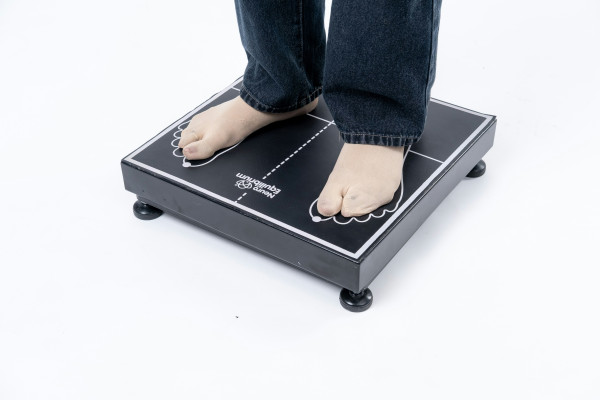
Marching on the spot, also known as the Fukuda stepping test or Unterberger test, can be harder than it sounds.
To perform it, stand in the middle of an open space, such as your living room. Mentally mark your starting point, then, with your eyes closed and your arms extended in front of you at 90 degrees, march on the spot for 30 seconds. A typical result is finishing in roughly the same spot you started.
In practice, when clients try this, many end up drifting, forward, backward, left, right, or some combination. That drift points to sub-optimal nervous system function.
The Fukuda stepping test assesses vestibular function and motor coordination. The vestibular system is a sensory system that provides your brain with information about motion, head position, and spatial awareness, all essential for normal movement and balance.
Beyond identifying a less-than-optimal vestibular system, the test can also indicate which side of the body a dysfunction sits on. If someone walks forward and rotates to the left, for instance, that typically points to the dysfunction being on the left.
Here's where it gets more detailed. The idea is that a joint with restricted movement (sometimes described as a subluxation) sends less information to the brain than its equivalent joint on the other side of the body. Over time, this reduced input is understood to affect the corresponding area of the brain responsible for motor function and coordination, and, depending on how much information that specific joint normally contributes (mapped on what's known as the somatosensory homunculus), it can meaningfully affect nervous system function and how the brain perceives and produces pain.
One way to think about this: your brain holds two main internal maps, or "blueprints." One reflects where your body actually is. The other reflects where your brain thinks your body is. When these two maps line up closely, your nervous system tends to function well, supporting proper movement with relatively few symptoms. When they diverge, you may lose coordination, balance, flexibility, strength, or posture, often showing up as pain, stiffness, or similar symptoms.
Put plainly: when joints move freely, the nervous system gets accurate information. When the nervous system gets accurate information, the brain's two internal maps tend to align. The Fukuda stepping test offers a simple, visible way to check this, since finishing close to your starting point suggests your movement and coordination systems are working well together. The broader idea is that when this alignment holds, people tend to experience fewer physical and cognitive symptoms overall.
What does it mean if I drift during the Fukuda stepping test? Drifting, whether forward, backward, or to one side, can indicate reduced vestibular function or an imbalance in how well one side of the body communicates with the brain compared to the other.
Is the Fukuda stepping test the same as other balance tests? It's related to other balance and vestibular assessments, like the Romberg test, but has its own specific procedure involving marching on the spot with eyes closed rather than simply standing still.
Can this test really identify which side of the body has an issue? It can offer an indication. The direction someone drifts during the test is often used alongside other clinical findings to help identify where an imbalance might be coming from.
What is the somatosensory homunculus? It's a way of mapping how much of the brain's processing capacity is dedicated to receiving information from different parts of the body. Areas that provide more detailed sensory information tend to have a larger representation.
Should I try this test at home to self-diagnose an issue? It's fine to try as a general point of curiosity, but interpreting the result accurately, and understanding what it might mean for you specifically, is best done alongside a trained professional rather than as a standalone diagnostic tool.