Slipped Disc: What It Really Means
Posted Nov 04, 2020 at 08:01

Posted Nov 04, 2020 at 08:01
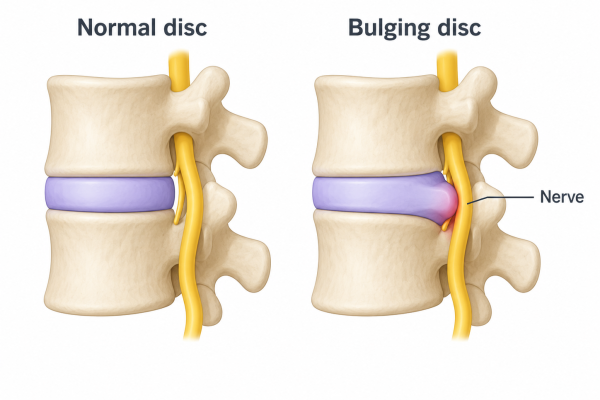
Many people think a disc can slip out of place.
But this is not true.
A “slipped disc” usually means there is a small tear, bulge or leak from one of the discs in the spine. The disc has not slipped out like a bar of soap. It is still between the bones of your spine.
The phrase “slipped disc” is often used because it is easy to remember. But it can also make people worry more than they need to.
At Peak Chiropractic, we believe people do better when they understand what is going on in their body. Clear answers can help you feel calmer and make better choices about your care.
A spinal disc is a cushion that sits between two bones in your spine.
You can think of it like a jam doughnut.
The outside is strong and firm. The middle is softer and more fluid-like.
If the outside layer becomes sore or damaged, the softer centre can push towards the edge. In some cases, it can press near a nerve. This may cause pain, pins and needles, numbness or pain down the leg.
Discs have an important job. They help your spine move. They help absorb force. They also help create space for nerves to leave the spine.
You have 23 discs in your spine. They sit between most of the bones in your neck, mid back and lower back.
No. A disc does not simply slip out of place.
Your spine is strong. Your bones, discs, joints, muscles and ligaments all work together to support you.
A disc problem is better described as a disc tear, disc bulge or disc leak. These words are more clear and more accurate than “slipped disc”.
This matters because the words we use can affect how we feel.
If someone thinks a disc has slipped out of place, they may feel scared to move. They may think their spine is weak or damaged. In many cases, this fear is not helpful.
A clear explanation can reduce worry and help you take the right next step.
A disc issue can cause different symptoms.
Some people feel pain in the lower back. Others feel pain that travels into the buttock, leg or foot. Some people notice pins and needles, numbness or weakness.
Symptoms may include:
These symptoms do not always mean you have a disc issue. Other problems can cause similar signs.
But if you have these symptoms, it is worth getting checked.
If you are searching for back pain treatment near me, lower back pain relief or a back pain chiropractor near me, the first step is to understand what is causing your pain.
Good care starts with a clear check.
During your first visit, we need to understand what may be causing your symptoms. If we think a disc issue may be involved, we also need to understand how severe it may be and which part of the spine may be affected.
This matters because care should not be random.
At Peak Chiropractic, we look at how your spine, joints, muscles and nerves are working together. We then build a plan based on what we find.
This is why many people search for a chiropractor near me or a back pain specialist near me when pain starts to affect normal life.
Many people with disc-related symptoms can improve with the right care, especially when they act early.
Care may focus on improving movement, reducing stress on the spine and helping the body work better.
This may include chiropractic care, movement advice, soft tissue work, rehab exercises and simple changes to daily habits.
People often search for chiropractic care near me or chiropractic treatment for sciatica when pain travels from the back into the leg.
Peak Chiropractic helps people with back pain, disc-related symptoms and sciatica across Stoke-on-Trent, Leek and Ashbourne.
We will never pretend chiropractic care is right for everyone.
Some disc issues need medical care or specialist support. If we think your problem needs a different type of help, we will tell you and guide you to the right place.
Our goal is to help you get the right care, even if that is not with us.
You should seek urgent medical help if you have loss of bladder or bowel control, numbness around the groin or saddle area, severe leg weakness, or symptoms that are quickly getting worse.
Peak Chiropractic supports people across Stoke-on-Trent, Leek, Ashbourne, Staffordshire and Derbyshire.
You can learn more about our local clinics here: chiropractor Stoke on Trent, chiropractor Leek, and chiropractor Ashbourne.
We also help people with neck pain, shoulder pain, hip pain, headaches and movement problems.
Like a dentist, we cannot help people we do not see.
Some disc symptoms are common, but that does not make them normal. Pain down the leg, pins and needles, numbness, leaning to one side or pain that keeps coming back should not be ignored.
The sooner you understand what is going on, the sooner you can make a clear plan.
If you are worried about a possible slipped disc, back pain or sciatica, book your initial consultation with Peak Chiropractic. You can also contact our team if you have questions before booking.
No. A disc does not slip out of place. A “slipped disc” usually means a disc tear, bulge or leak that may irritate nearby nerves.
A disc issue may cause lower back pain, pain down the leg, pins and needles, numbness, weakness or pain that changes when sitting or standing.
Chiropractic care may help some people with disc-related pain by improving movement and reducing stress on the spine. At Peak Chiropractic, we assess you first to see what care is right for you.
Seek urgent medical help if you lose bladder or bowel control, have numbness around the groin or saddle area, have severe leg weakness, or your symptoms are quickly getting worse.
Peak Chiropractic has clinics in Stoke-on-Trent, Leek and Ashbourne. We help people with back pain, sciatica, stiffness and movement problems.