Why a Knee Pain Chiropractor Looks Beyond Your Brace
Posted Jul 27, 2026 at 15:13

Posted Jul 27, 2026 at 15:13
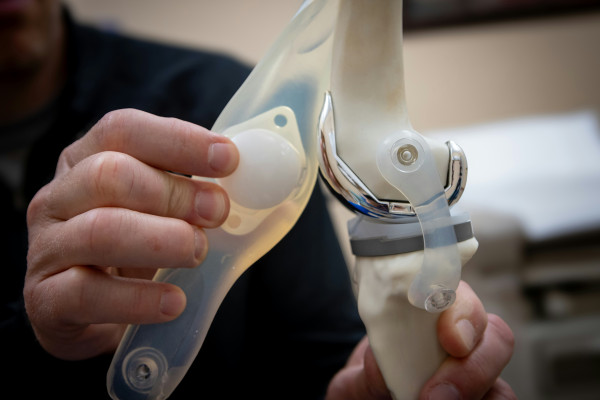
Are you only pain free while wearing a knee brace, elbow support, or some other joint orthotic? If that sounds familiar, the support itself might quietly be doing you more harm than good.
Orthotics, joint supports, and weight belts are artificial devices that create a false sense of stability around your joints, and that manufactured stability is precisely what reduces your pain in the short term. The problem is, this apparent fix quietly causes a knock-on issue of its own.
Your joints stay genuinely stable thanks to three separate systems working together: your nervous system, your active muscular system, and your passive connective tissues, meaning ligaments, tendons, and similar structures. A support doesn't strengthen any of these three underlying systems; it simply replaces what they should already be doing on their own.
When a joint receives an external support, that area effectively stops working as hard as it used to, and it gradually weakens over time as a direct consequence. Take someone with knee pain as an example. They may only feel pain free while wearing their support. Over time, the knee learns to rely entirely on that external support, so the brain no longer sees any real need to activate the knee's stabilising muscles, send useful information back through the nervous system, or maintain healthy tension in the surrounding tissues. Systems that get used less simply get weaker, and that weakness rarely stays contained to one joint.
This is a pattern our clinical team encounters regularly: people who wore supports that seemingly "sorted" their original problem, only to arrive months later with an entirely fresh list of aches and pains elsewhere in the body. All that support really did was redirect the stress somewhere else entirely.
Once a joint stops pulling its own weight, the surrounding anatomical structures inevitably pick up the slack instead. A knee that's propped up by a brace can quietly shift extra load to the hip, the opposite leg, or even the lower back. This is precisely why supports can make you worse rather than better, regardless of whether they've genuinely reduced your original pain.
A support never genuinely addresses why a stability issue developed in that particular area in the first place. Going back to the knee brace example, the support offloads stress from the knee, so the pain drops, but the actual cause of the issue is still very much present underneath. What's really happening is a reduction in symptoms rather than a genuine cure, accompanied by a quiet redistribution of strain toward another part of your body entirely.
Many people who visit a chiropractor for knee pain are surprised to learn their brace has quietly been part of the problem, not the solution.
By correcting the neuromuscular function of the muscles around a joint, you create genuine, lasting stability, and that's when the artificial devices can finally come off for good. This is exactly the kind of underlying correction we build into every treatment plan, rather than simply masking symptoms with an external prop.
For athletes and active people especially, this matters a great deal. A chiropractor for sports injuries will often see supports used as a short-term crutch after an injury, when what's actually needed is hands-on work from our myofascial team to rebuild strength and control in the muscles that should be doing the stabilising work.
Rather than treating the symptom in isolation, we look at why your joint lost its stability in the first place. That might involve muscle activation work, movement retraining, or addressing weaknesses elsewhere in the kinetic chain that are placing extra demand on the joint that hurts. It's a more thorough process than simply strapping on a support, but it's the difference between managing a problem indefinitely and actually resolving it.
Are knee braces always bad?
Not always. Short-term use after an acute injury can be genuinely helpful, but long-term reliance without addressing the underlying weakness tends to make things worse over time.
Why does my pain come back as soon as I remove my support?
Because the support was masking symptoms rather than resolving the true cause. Once it's removed, the underlying instability is still there.
Can weak stabilising muscles really cause pain elsewhere?
Yes. When one joint compensates for reduced support, nearby joints and muscles often take on extra strain, which can lead to new aches in places you'd never expect.
How long does it take to build real stability?
It depends on how long the muscles have been under-used, but most clients notice meaningful change within a few months of consistent, targeted work.
Do I need to stop wearing my support straight away?
Not necessarily. If you search for a knee pain chiropractor near me, look for one who'll help you transition off a support gradually and safely, alongside a plan to rebuild the strength underneath it. Get in touch with our team to find out more.
Want to learn more about how we correct neuromuscular function and how long it might take for you? Come and see us for a free discovery visit.