We Test Muscles Before Treating Joints
Posted Aug 21, 2026 at 17:59

Posted Aug 21, 2026 at 17:59
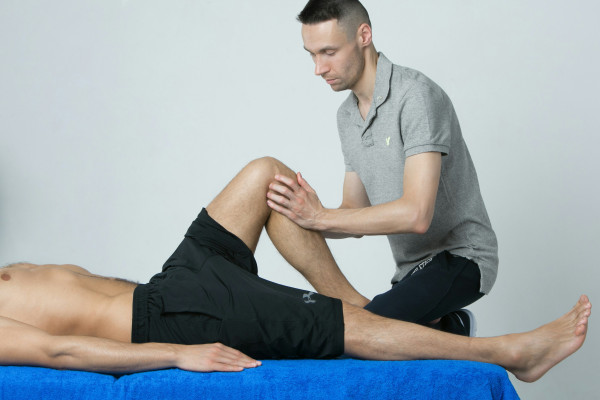
We use muscle testing with every single client who walks through our doors. It is a core part of how we assess what is actually going on inside your body, rather than simply guessing based on where it hurts.
Muscle testing is a technique used to assess how strongly a muscle activates when asked to work. Muscles move and stabilise your joints, so a fully functioning joint genuinely depends on fully functioning muscles around it. When we assess muscle activation, we are typically testing something deeper than the muscle itself: the nervous system's ability to communicate with and properly activate that muscle. A weak or inactive muscle is rarely an isolated muscular problem on its own. In the vast majority of cases, the real issue sits within the nervous system.
To be clear, we are not testing whether you could kick down a wall, which would simply measure raw strength or speed. Instead, we check whether you can activate a specific muscle and hold steady against gentle resistance, in one direction, for two seconds or more. That distinction matters, because it isolates activation from strength.
There are several clear signs that tell us a muscle is inhibited, meaning it has effectively switched off. These include cramping during the test, an inability to hold the starting position, a shift in the direction of the movement, recruiting nearby muscles to compensate, altering body position to cheat the test, or pushing erratically to disguise a lack of genuine activation. If any of these signs appear, we consider the muscle inhibited, and the search for its underlying cause begins immediately.
An inactive muscle causes trouble for several interconnected reasons. First, a switched-off muscle cannot properly stabilise its corresponding joint, which often leads to dysfunction in that joint, or in a neighbouring joint through compensatory movement patterns. Second, when one muscle stops pulling its weight, the surrounding muscles are forced to work harder. In the short term, this extra strain inflames those muscles and creates pain. Over the longer term, the strength gap between the inactive muscle and its overworked neighbours steadily widens, making the underlying problem progressively worse.
Perhaps most importantly, if a muscle remains switched off for two months or longer, your nervous system gradually adapts to that dysfunction and treats it as the new normal. This means genuine dysfunction can start to feel entirely normal, and you may not notice a problem again until it worsens considerably.
The solution to inhibited muscle activation follows three clear stages. First, we identify precisely which muscles are inhibited or inactive through careful, hands-on testing. Second, we search for the true root cause within the nervous system itself, rather than treating the muscle in isolation, an approach that sits at the centre of our wider approach to identifying the true cause of your symptoms. Third, we treat that identified cause consistently over two to four months, giving the nervous system enough time to repattern and genuinely adapt back to a normal, functioning state.
This structured process is precisely why our clients often see us for more than a single session. Real neurological change takes sustained, targeted input, not a one-off adjustment, which is exactly why muscle testing forms one part of our structured six-step system for lasting recovery.
Muscle testing rarely stands alone in a proper assessment. It works alongside a broader understanding of how your brain interprets signals from the rest of your body, a relationship explained further on our page about how the brain and nervous system shape physical function. Together, these tools give us a genuinely accurate picture of what is driving your symptoms, rather than a surface-level guess.
If you are searching for the best chiropractor near me, ask whether muscle testing forms part of their assessment process. A thorough chiropractic clinic near me should be able to explain precisely which muscles are underperforming and why, rather than simply treating wherever you happen to feel discomfort that day.
Does muscle testing hurt?
No. It uses gentle, controlled resistance rather than heavy force, and most clients find the process comfortable.
How is muscle testing different from a standard strength test?
A strength test measures raw power. Muscle testing checks whether a muscle activates properly and holds steady, which shows how well your nervous system talks to it.
Can a muscle be weak without me noticing any pain?
Yes, and this is common. If a muscle has been inactive for some time, your nervous system may have adapted to the dysfunction, meaning you feel no obvious symptoms until the problem progresses further.
Why does treatment take two to four months rather than a single session?
Genuine neurological repatterning takes sustained, consistent input over time. A single session can help, but lasting change requires the nervous system to adapt gradually.
Will you test every muscle in my body?
Not every visit, but muscle testing is used consistently throughout your care to track which areas are inhibited and how they respond as your treatment progresses.